


How Does a Commercial Battery Energy Storage System Work? A Complete Guide
Commercial battery energy storage systems (BESS) are becoming an important part of modern energy management for factories, commercial buildings, industrial facilities, and renewable energy projects. By storing electricity and releasing it when needed, a commercial BESS helps businesses manage power demand, improve solar energy utilization, and increase energy flexibility.
But how does a commercial battery energy storage system actually work? What happens when the battery charges and discharges? How do the battery modules, power conversion system (PCS), energy management system (EMS), and other components work together?
This guide explains the working principle of commercial battery energy storage systems, their main components, operating processes, and practical applications.
A commercial battery energy storage system is an integrated solution designed to store electrical energy and deliver it to a facility or the grid when required.
Unlike a simple battery pack, a commercial BESS combines several components, including battery modules, a battery management system (BMS), a power conversion system (PCS), an energy management system (EMS), thermal management equipment, and electrical protection devices.
These components work together to control energy storage, power conversion, system operation, and safety.
Commercial BESS solutions are commonly used in:
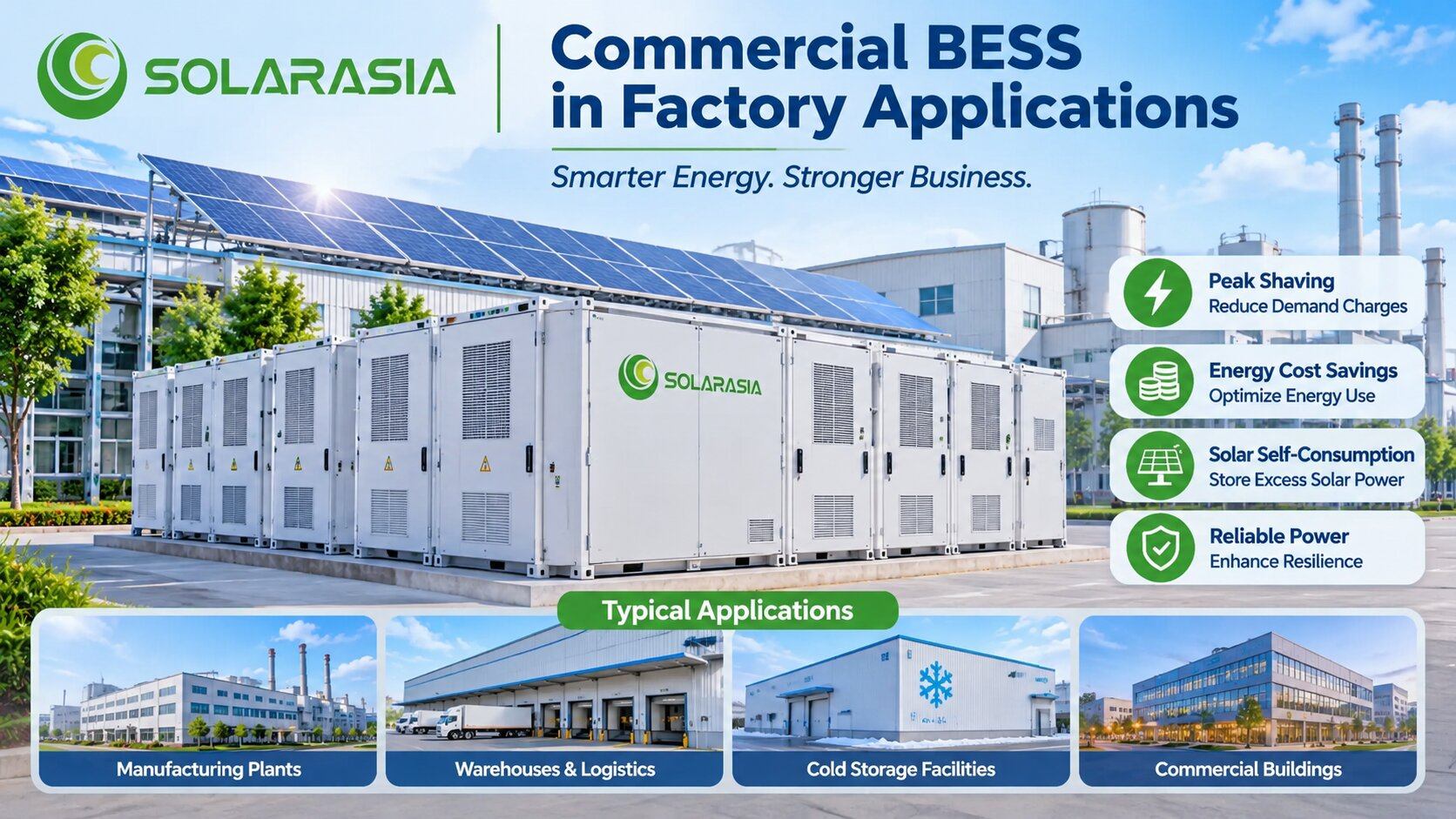
Manufacturing plants and industrial facilities
Commercial buildings and office complexes
Warehouses and logistics centers
Cold storage and food processing facilities
Solar power projects
Microgrids and distributed energy systems
Depending on project requirements, a commercial battery storage system can operate independently, work with rooftop solar panels, or connect to the utility grid.
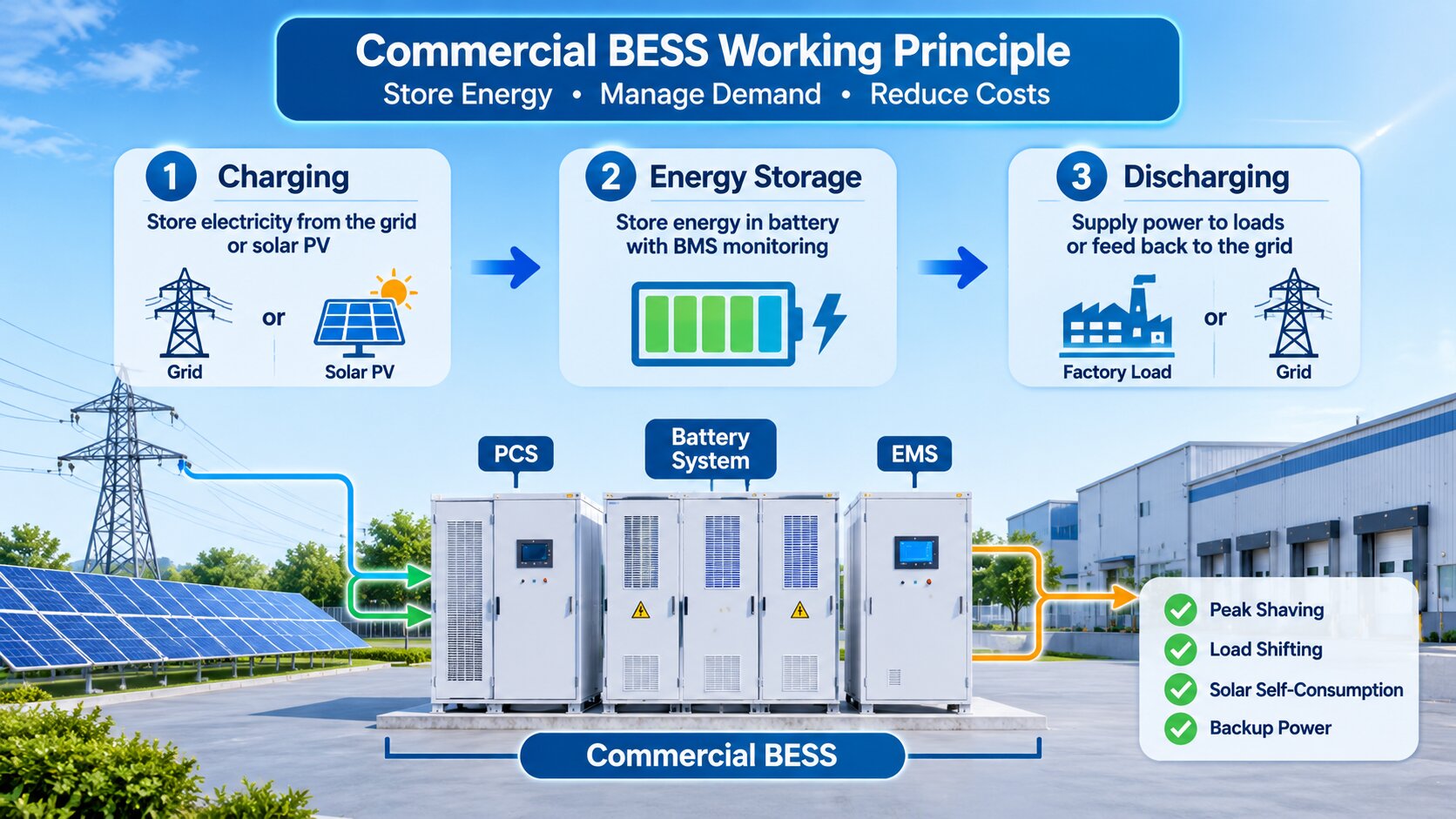
The basic working principle of a commercial BESS is straightforward: it stores electricity when energy is available or economically favorable and releases stored electricity when the facility needs it.
A typical grid-connected commercial BESS follows three main stages.
During the charging process, electricity comes from the utility grid, a solar PV system, or another compatible power source.
The PCS converts electrical power into the form required by the battery system. For a typical AC-coupled configuration, the PCS converts AC electricity into DC electricity for battery charging.
The battery cells store this energy through electrochemical reactions.
The BMS continuously monitors important battery parameters, including voltage, current, temperature, and state of charge (SOC), to help maintain safe operating conditions.
Once charging is completed or the required SOC is reached, the battery stores the energy until it is needed.
During this period, the BMS monitors battery operating conditions, while the EMS coordinates the overall energy management strategy.
The EMS can consider factors such as:
Electricity prices during different periods
Facility electricity demand
Solar PV generation
Battery SOC
Charging and discharging power limits
Grid operating conditions
Backup power requirements
Based on the configured strategy and system capabilities, the EMS determines when the battery should charge, discharge, or remain idle.
When electricity demand increases or electricity prices become higher, the BESS can release stored energy.
In a typical AC-coupled system, the PCS converts DC electricity from the battery into AC electricity that can supply compatible facility loads or export to the grid when permitted.
The EMS controls the discharge process according to the configured operating strategy.
For example, a factory may charge its battery during off-peak electricity periods and discharge it during peak demand periods to reduce electricity costs.
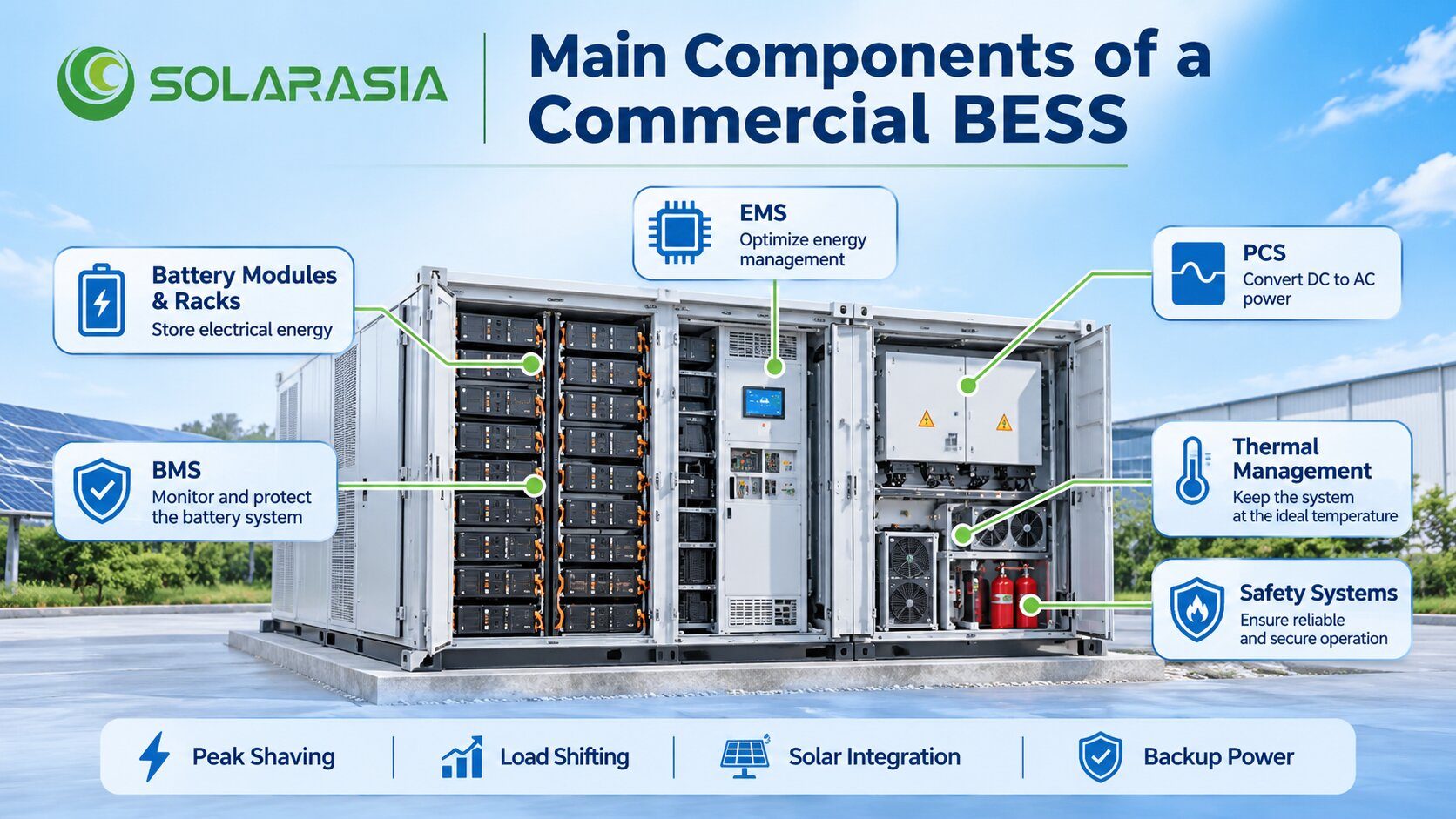
A commercial battery energy storage system is made up of several interconnected components. Each component performs a specific function.
The battery is the core energy storage component of a BESS.
Commercial systems commonly use lithium iron phosphate (LiFePO4 or LFP) battery technology because of its combination of cycle life, thermal characteristics, and suitability for stationary energy storage.
Multiple battery cells are assembled into modules, and modules are connected into racks or larger battery assemblies.
The total battery capacity determines how much energy the system can store, usually measured in kilowatt-hours (kWh) or megawatt-hours (MWh).
For example:
100 kWh: A smaller commercial energy storage application
215 kWh: A common capacity class for commercial and industrial storage cabinets
261 kWh: A higher-capacity commercial storage configuration
1 MWh: A larger energy storage installation
Actual system capacity, usable energy, and discharge capability depend on the battery configuration and manufacturer specifications.
The BMS monitors and manages the battery system.
Its main responsibilities include:
Monitoring individual cell and battery module voltages
Monitoring battery temperature
Measuring current and calculating SOC
Detecting abnormal operating conditions
Managing cell balancing where supported
Providing protection signals and communication with other equipment
The BMS helps maintain battery operation within the limits defined by the manufacturer.
A reliable BMS is essential for commercial battery storage because it supports battery monitoring, operational control, and fault protection.
The PCS is responsible for converting electrical power between AC and DC.
In a typical commercial BESS:
During charging, the PCS converts AC electricity into DC electricity.
During discharging, the PCS converts DC electricity into AC electricity.
The PCS also controls charging and discharging power according to system commands and operating limits.
Its rated power is generally measured in kilowatts (kW) or kilovolt-amperes (kVA).
The PCS power rating determines how quickly the battery can charge or discharge, subject to battery and system limitations.
The EMS acts as the control center for overall energy management.
It coordinates the operation of the battery, PCS, solar PV system, and other connected equipment where supported.
Typical EMS functions include:
Monitoring electricity consumption
Managing battery charging and discharging
Optimizing energy use according to electricity tariffs
Coordinating solar power and battery storage
Managing peak demand
Recording operational data and system alarms
For commercial and industrial applications, an effective EMS helps businesses implement different energy management strategies based on their operating requirements.
Battery performance and operating conditions are influenced by temperature.
Commercial BESS installations may use air cooling or liquid cooling, depending on system design and capacity.
Thermal management helps maintain battery operating temperatures within the manufacturer's specified range.
Other safety-related equipment may include temperature sensors, smoke or gas detection, fire protection equipment, emergency shutdown functions, and electrical protection devices.
The exact configuration should be determined by the system design, applicable regulations, installation environment, and manufacturer requirements.
A commercial battery storage system can be connected to the facility's electrical infrastructure in different ways.
Two common configurations are AC-coupled and DC-coupled systems.
In an AC-coupled configuration, the battery storage system connects to the AC side of the electrical system through a PCS.
A typical arrangement includes:
Utility grid
AC distribution system
PCS
Battery system
Building or factory loads
Solar inverter, if solar PV is installed
One advantage of AC coupling is that the battery system can often be integrated with an existing solar PV installation without replacing the existing solar inverter.
However, additional conversion stages may affect overall energy conversion efficiency.
In a DC-coupled configuration, the battery and solar PV system are connected through a shared DC-side architecture.
Depending on the system design, solar electricity can be directed to the battery through DC conversion equipment before being converted into AC power for facility loads.
Potential advantages include fewer conversion stages for certain energy flows and flexible integration with solar generation.
However, DC-coupled systems require compatible equipment and careful electrical system design.
| Comparison | AC-Coupled | DC-Coupled |
|---|---|---|
| Connection Point | AC side | DC side |
| Existing Solar System Integration | Often easier | Depends on equipment compatibility |
| Power Conversion | Separate conversion stages may be used | Shared DC-side architecture may reduce some conversion stages |
| System Design | Flexible for many retrofit projects | Requires compatible DC-side equipment |
| Typical Application | Existing solar PV plus battery storage | New solar and storage projects |
There is no universally better configuration. The right choice depends on the existing electrical infrastructure, solar inverter, battery system, project budget, and operating objectives.
A commercial BESS can support several energy management strategies.
Peak shaving means using stored battery energy to reduce electricity demand during periods of high power consumption.
For example, if a factory reaches a peak demand of 400 kW, a battery system may discharge during the peak period to reduce the power drawn from the grid.
If the BESS supplies 100 kW at the appropriate time, grid demand could be reduced to approximately 300 kW.
The actual result depends on the load profile, battery power rating, available energy, control strategy, and utility billing rules.
Some electricity tariffs have different prices during peak, shoulder, and off-peak periods.
A BESS can charge during lower-price periods and discharge during higher-price periods.
This strategy is known as energy arbitrage.
The financial benefit depends on the price difference, charging and discharging efficiency, battery degradation, and applicable electricity tariff structure.
When a commercial building has rooftop solar panels, electricity generation may not always match the facility's consumption.
During periods of high solar generation, excess electricity can be stored in the battery instead of being exported or curtailed, subject to system configuration and grid rules.
Later, the stored energy can be used when solar generation decreases.
This helps improve solar energy self-consumption and reduce reliance on grid electricity.
A properly designed BESS can provide backup power to selected loads during a grid outage.
However, not every grid-connected battery system automatically provides backup power.
Backup operation may require additional equipment and functions, such as:
Grid-forming or backup-capable PCS
Isolation and transfer equipment
Suitable protection and control systems
Defined critical-load circuits
Islanding operation capability
Businesses should confirm backup power functionality before purchasing a commercial BESS.
Consider a manufacturing facility that wants to reduce peak demand and improve its electricity management.
The facility selects a commercial battery storage system with the following illustrative configuration:
| Parameter | Example Value |
|---|---|
| Rated Power | 100 kW |
| Nominal Battery Capacity | 215 kWh |
| Application | Peak Shaving |
| Charging Source | Utility Grid / Solar PV |
| Discharging Source | Battery Storage |
| Control System | EMS |
| Battery Technology | LiFePO4 |
Assume the factory has a high-demand period when its electricity consumption reaches 400 kW.
During this period, the EMS sends a discharge command to the PCS. The PCS converts battery DC power into AC power and supplies 100 kW to the facility's electrical system.
The grid then supplies approximately 300 kW instead of 400 kW, assuming the battery can deliver the required power and the facility's electrical configuration supports this operation.
The nominal battery energy is 215 kWh. At a constant 100 kW discharge rate, the theoretical duration would be:
215 kWh ÷ 100 kW = 2.15 hours.
This is a theoretical calculation based on nominal capacity. Actual operating duration will be affected by usable battery capacity, SOC limits, conversion efficiency, temperature, and equipment power limits.
This example illustrates how battery power and energy capacity work together in a commercial BESS.
The actual performance of a commercial battery energy storage system depends on several technical and operational factors.
Battery capacity determines the total amount of energy that can be stored.
A larger capacity may support longer discharge periods, but the required capacity should be based on actual energy consumption and project objectives.
The PCS determines the maximum conversion power supported by the system.
A system with insufficient PCS power may not deliver the required peak-shaving or backup output, even if it has a large battery capacity.
High or low temperatures can affect battery performance and charging or discharging limits.
Thermal management should follow the manufacturer's operating requirements.
Energy is lost during power conversion and battery operation.
Therefore, the electricity delivered by a BESS is lower than the electricity used to charge it.
An effective EMS should match the battery operating strategy to the facility's actual load profile, electricity tariffs, solar generation, and operating schedule.
Poorly configured charging and discharging schedules may reduce the expected economic benefits.
Transformers, switchgear, cables, circuit breakers, protection systems, and grid connection conditions can all affect system integration.
A proper electrical assessment is necessary before installation.
Selecting a suitable BESS requires more than comparing battery capacity and product prices.
Businesses should evaluate the following factors.
1. Analyze Electricity Consumption
Collect historical electricity bills, interval load data, peak demand records, and operating schedules.
2. Define the Main Application
Determine whether the main objective is peak shaving, energy arbitrage, solar self-consumption, backup power, or a combination of applications.
3. Calculate Required Power and Energy
The PCS power rating should meet the required charging and discharging power, while battery capacity should support the required operating duration.
4. Evaluate Battery Technology
Compare battery chemistry, usable capacity, operating temperature, cycle-life conditions, and warranty terms.
5. Check System Compatibility
Confirm compatibility among the battery, PCS, EMS, solar inverter, and existing electrical infrastructure.
6. Review Safety and Certifications
Check the actual product documentation, applicable certifications, installation requirements, and local electrical and fire safety regulations.
7. Evaluate Supplier Capabilities
Consider manufacturing capability, engineering support, customization options, technical documentation, warranty coverage, and after-sales service.
For businesses planning a new installation, working with an experienced commercial BESS supplier can help simplify system configuration and project implementation.
Commercial battery energy storage systems can support a wide range of business operations.
| Industry | Typical BESS Application |
|---|---|
| Manufacturing | Peak shaving and demand management |
| Commercial Buildings | Electricity cost optimization |
| Warehouses | Solar self-consumption and peak demand reduction |
| Cold Storage | Refrigeration load management and backup support |
| Data Centers | Support for power resilience strategies |
| Solar Farms | Energy shifting and grid support where permitted |
| Industrial Parks | Coordinated energy management |
Each project has different electricity consumption patterns, grid conditions, and financial objectives. Therefore, BESS capacity and configuration should be customized according to the specific application.
Understanding how a commercial battery energy storage system works is the first step toward selecting the right energy storage solution.
A properly designed BESS integrates battery modules, BMS, PCS, EMS, thermal management, and electrical protection into one coordinated system.
For industrial and commercial users, the right configuration can support peak shaving, time-of-use energy management, solar self-consumption, and backup power applications where the required functions are available.
At SOLARASIA, we provide commercial and industrial battery energy storage solutions for different project requirements. Our team can help evaluate system capacity, power configuration, battery technology, and customized integration options.
Planning a commercial battery storage project?
Contact our team to discuss your project requirements and request a customized BESS solution.
Application: Factory, warehouse, commercial building, or solar project
Required Power: kW
Required Energy Capacity: kWh
Main Application: Peak shaving, solar integration, energy arbitrage, or backup power
Project Location: Country or region
Explore our Commercial and Industrial Battery Energy Storage Solutions and contact SOLARASIA for more information.
A commercial BESS stores electricity from the grid, solar PV, or another compatible source. When energy is needed, the PCS converts the stored DC electricity into AC power for compatible loads or grid export where permitted. The BMS and EMS monitor and coordinate system operation.
The main components typically include battery modules, a battery management system (BMS), power conversion system (PCS), energy management system (EMS), thermal management equipment, and electrical protection devices.
Yes. A commercial BESS can be integrated with a solar PV system using a compatible AC-coupled or DC-coupled configuration. The battery can store available solar energy and discharge it when required.
The duration depends on usable battery capacity and the connected load. For example, a 215 kWh battery theoretically supports a 100 kW load for 2.15 hours before considering usable capacity limits and conversion losses.
The BMS focuses on battery monitoring and protection, including voltage, current, temperature, and SOC. The EMS manages the overall energy system, coordinating charging, discharging, grid interaction, and energy optimization strategies.
No. Backup power requires a system designed for that function, including compatible PCS capabilities, isolation equipment, protection, and suitable critical-load connections. Buyers should confirm backup operation capability before installation.
LiFePO4 is widely used in commercial and industrial energy storage because of its cycle-life characteristics and thermal properties. However, system safety and performance also depend on cell quality, BMS design, thermal management, installation, and operating conditions.
Start by analyzing electricity consumption, peak demand, load profiles, solar generation, and operating objectives. Then determine the required PCS power in kW and battery energy capacity in kWh based on the intended application and discharge duration.


عنوان : Room 908-909, Building 2, No. 469 Huatuo Lane, Shushan District, Hefei City, Anhui Province


من فضلك تابع القراءة، ابق على اطلاع، اشترك، ونحن نرحب بك لتخبرنا برأيك.
Links: Inverter Cables
Sunrangeenergy
gmsolarkit
حقوق النشر
2026 @ انهوى Solarasia تكنولوجيا الطاقة المحدودة .جميع الحقوق محفوظة
. خريطة الموقع
| المدونة
| XML | سياسة الخصوصية
 الشبكة المدعومة
